Maria Montessori Notable Quotes & Links for Learning.
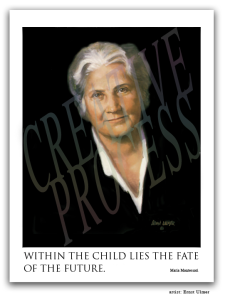

Maria Montessori (Aug 31, 1870-May 6, 1952) is best known today for the method of education she originally developed to teach under privileged children in urban slums. Dr. Montessori observed that these presumed “feeble-minded” children were inherently gifted with an “absorbent mind” and would flourish in prepared environments with age sensitive activities that involve exploration, manipulations, order, repetition, abstraction, and communication.
The first woman to earn a medical degree in Italy (1896), Montessori was nominated for the Nobel Peace Prize 1949, 1950, and 1951*.
The year 2027 will mark the 120th anniversary of Montessori education.
*FYI - Nobel Peace Prize winners in '49, '50, & '51 were Lord Boyd-Orr, Ralph Bunch and Léon Jouhaux.
"Within the child lies the fate of the future."
The Secret of Childhood
From the Foreword
The children in a Montessori class are given freedom, which is the liberty of the human being, and this freedom allows the children to grow in social grace, inner discipline, and joy. These are the birthrights of human beings who have been allowed to develop essential human qualities, and again, Montessori teachers from all over the world would furnish examples of these. "Excuse me," said a child to a visitor commenting in a classroom that this was the Method where the children could do as they liked, "I do not know if we do as we like, but I know that we like what we do." (book description)
“If the idea of the universe is presented to the child in the right way, it will do more for him than just arouse his interest, for it will create in him admiration and wonder, a feeling loftier than any interest and more satisfying.” “To Educate the Human Potential”
“The essence of independence is to be able to do something for one’s self. Adults work to finish a task, but the child works in order to grow, and is working to create the adult, the person that is to be. Such experience is not just play... it is work he must do in order to grow up.”
“We give the name scientist to the type of man who has felt experiment to be a means guiding him to search out the deep truth of life, to lift a veil from its fascinating secrets, and who, in this pursuit, has felt arising within him a love for the mysteries of nature, so passionate as to annihilate the thought of himself. The scientist is not the clever manipulator of instruments, he is the worshipper of nature and he bears the external symbols of his passion as does the follower of some religious order. To this body of real scientists belong those who, forgetting, like the Trappists of the Middle Ages, the world about them, live only in the laboratory, careless often in matters of food and dress because they no longer think of themselves; those who, through years of unwearied use of the microscope, become blind; those who in their scientific ardour inoculate themselves with tuberculosis germs; those who handle the excrement of cholera patients in their eagerness to learn the vehicle through which the diseases are transmitted; and those who, knowing that a certain chemical preparation may be an explosive, still persist in testing their theories at the risk of their lives. This is the spirit of the men of science, to whom nature freely reveals her secrets, crowning their labours with the glory of discovery.
There exists, then, the “spirit” of the scientist, a thing far above his mere “mechanical skill,” and the scientist is at the height of his achievement when the spirit has triumphed over the mechanism. When he has reached this point, science will receive from him not only new revelations of nature, but philosophic syntheses of pure thought.” ~ The Montessori Method, Ch. 1 : A Critical Consideration of the New Pedagogy in its Relation to Modern Science, p. 8
MORE Science Quotes
“Those things which we call encouragement, comfort, love, respect, are drawn from the soul of man, and the more freely we give of them, the more do we renew and reinvigorate the life about us.” ~ The Montessori Method chapter 2
“Life makes itself manifest, -life creates, life gives: -and is in its turn held within certain limits and bound by certain laws which are insuperable.” The Montessori Method, chapter 4
“The child ... in his eagerness for knowledge, has revealed himself as a true son of that humanity which has been throughout centuries the creator of scientific and civil progress.” ~ The Montessori Method, chapter 22
“Children become like the things they love.” ~ The Absorbent Mind
The Montessori Reader has The Absorbent Mind, Montessori Method and Dr. Montessori's Own Handbook in one volumn
"Maria Montessori relates how a vision and prophecy of Ezekiel influenced her - “In fact, the words–‘I will cause breath to enter into you, and ye shall live,’ seem to me to refer to the direct individual work of the master who encourages, calls to, and helps his pupil, preparing him for education.”
“But if for the physical life it is necessary to have the child exposed to the vivifying forces of nature, it is also necessary for his psychical life to place the soul of the child in contact with creation.” source unknown
“The needs of mankind are universal. Our means of meeting them create the richness and diversity of the planet. The Montessori child should come to relish the texture of that diversity.” source unknown
“The child has other powers than ours, and the creation he achieves is no small one; it is everything.”
“Man is a sculptor of himself, urged by a mysterious inner force to the attainment of an ideal determined form.” Rome, 1913
“Imagination does not become great until human beings, given the courage and strength, use it to create.”
“Here is an essential principle of education: to teach details is to bring confusion; to establish the relationship between things is to bring knowledge.” from Childhood to Adolescence, p. 58.
"The child should not be regarded as a feeble and helpless creature whose only need is to be protected and helped, but as a spiritual embryo, possessed of an active psychic life from the day that he is born and guided by subtle instincts enabling him to actively build up the human personality. And since it is the child who becomes the adult man, we must consider him as the true builder of mankind.” ~ Montessori, Education and Peace (Chicago: Regnery, 1972), p. 41.
AN APPRECIATION OF MONTESSORI
Buckminster Fuller, 1972
“All children are born geniuses. 9999 out of every 10,000 are swiftly, inadvertently, degeniused by grown-ups. This happens because human beings are born naked, helpless, and, though superbly equipped cerebrally, utterly lacking in experience and, therefore, utterly ignorant. Their delicate sensing equipment is, as yet, untried. Born with built-in hunger, thirst, curiosity, the procreative urge, they can only learn what humanity has learned by trial and error by billions upon billions of errors. Yet humanity is also endowed with self-deceiving pride. All those witnessing the errors of others proclaim that they (the witnesses) could have prevented those errors had they only been consulted. “People should not make mistakes,” they mistakenly say. Motivated entirely by love but also by fear for the futures of the children they love, parents, in their ignorance, act as though they know all the answers and curtail the spontaneous exploratory acts of their children, lest the children make “mistakes.” But genius does its’ own thinking; it has confidence in its own exploratory findings, in its own intuitions, in the knowledge gained from its own mistakes. Nature has her own gestation rates for evolutionary development. The actions of parents represent the checks and balances of nature’s gestation control. Humanity can evolve healthily only at a given rate. Maria Montessori was fortunately permitted to maintain, sustain, and cultivate her innate genius. Her genius invoked her awareness of the genius inherent in allchildren. Her intuition and initiative inspired her to discover ways of safe guarding this genius while allaying the ignorant fears of parents. But the way was not always easy. Hers was the difficult: frontiering task of genius.”
The Maria Montessori No One Knows Part I
Dr. Robert Gardner, EdD, Professor Emeritus, Ryerson Unversity.
“We are always too busy for our children; we never give them the time or interest they deserve. We lavish gifts upon them; but the most precious gift, our personal association, which means so much to them, we give grudgingly.” Twain: A Biography: 1835-1910, Complete (You may be interested in Mark Twain, Global PathMarker.)
“The modern world is dangerous, confusing, not meant for children, not generally kind or welcoming to them. We have much to learn about how to make the world more accessible to them, and how to give them more freedom and competence in exploring it. But this is a very different thing from designing nice little curricula.” ~ John Holt: