Carl Gustav Jung Links for Learning: Quotes, Books, Videos
Inspiration and Motivational quotes, books, videos, for learning about Carl Gustav Jung.
Integrating his lifelong spiritual attitude (Jung was the son of a pastor in the Swiss Reformed Church and his maternal grandfather a churchman and academic) with a scientific investigation of dreams and fantasies led him to study both Eastern and Western philosophy and religions as “archaeological” evidence of the evolution of human consciousness to individuation, the growth toward psychic wholeness that was the meaning of life, and the creative activity of God.
Jung’s thought was highly influential in the formation of the help group Alcoholics Anonymous, where the necessity of a spiritual experience is primary in ending a physical addiction.
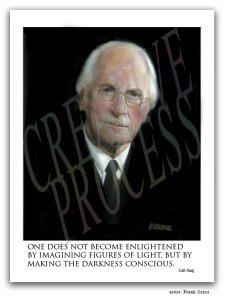
"One does not become enlightened by imagining figures of life, but by making the darkness conscious." Quote source: Alchemical Studies, Vol 13, paragraph 335 (pg 265)
“Among all my patients in the second half of life ... there has not been one whose problem in the last resort was not that of finding a religious outlook on life.” Modern Man in Search of a Soul, Chap. 11 (Psychotherapists or the Clergy), p. 229
"It makes no difference whether the poet knows that his work is begotten, grows and matures with him, or whether he supposes that by taking thought he produces it out of the void. His opinion of the matter does not change the fact that his own work outgrows him as a child its mother. The creative process has feminine quality, and the creative work arises from unconscious depths--we might say, from the realm of the mothers. Whenever the creative force predominates, human life is ruled and molded by the unconscious as against the active will, and the conscious ego is swept along on a subterranean current, being nothing more than a helpless observer of events. The work in process becomes the poet's fate and determines his psychic development. It is not Goethe who creates Faust, but Faust which creates Goethe....The archetypal image of the wise man, the saviour or redeemer, lies buried and dormant in man's unconscious since the dawn of culture; it is awakened whenever the times are out of joint and a human society is committed to a serious error. When people go astray they feel the need of a guide or teacher or even of the physician. These primordial images are numerous, but do not appear in the dreams of individuals or in works of art until they are called into being by the waywardness of the general outlook. When conscious life is characterized by one-sidedness and by a false attitude, then they are activated--one might say, 'instinctively' – and come to light in the dreams of individuals and the visions of artists and seers, thus restoring the psychic equilibrium of the epoch." ~ Modern Man In Search of a Soul
“....This is why every great work of art is objective and impersonal, but none the less profoundly moves us each and all. And this is also why the personal life of the poet cannot be held essential to his art--but at most a help or a hindrance to his creative task. He may go the way of a Philistine, a good citizen, a neurotic, a fool or a criminal. His personal career may be inevitable and interesting, but it does not explain the poet." ~ Modern Man in Search of a Soul, pp. 168-171.
“Every creative person is a duality or a synthesis of contradictory aptitudes. On the one side he is a human being with a personal life, while on the other side he is an impersonal, creative process...The artist is not a person endowed with free will who seeks his own ends, but one who allows art to realize its purposes through him. As a human being he may have moods and a will and personal aims, but as an artist he is ‘man' in a higher sense – he is ‘collective man’ – one who carries and shapes the unconscious, psychic life of mankind. To perform this difficult office it is sometimes necessary for him to sacrifice happiness and everything that makes life worth living for the ordinary human being. art spirit." ~ Modern Man In Search of a Soul
“Just as conscious contents can vanish into the unconscious, other contents can also arise from it. Besides a majority of mere recollections, new thoughts and creative ideas can appear that have never been conscious before. They grow up from the dark depths like a lotus.” Approaching the Unconscious, Man and His Symbols, 1964, CW 18: p3
(Jung, encouraged to write for the general reader penned Man and His Symbols is a guide to understanding our dreams and interrogating the many facets of identity—our egos and our shadows, “the dark side of our natures.”)
"Modern man does not understand how much his ‘rationalism’ (which has destroyed his capacity to respond to numinous symbols and ideas) has put him at the mercy of the psychic ‘underworld’. He has freed himself from ‘superstition’ (or so he believes), but in the process he has lost his spiritual values to a positively dangerous degree. His moral and spiritual tradition has disintegrated, and he is now paying the price for this break-up in worldwide disorientation and dissociation.”
C. G. Jung, Approaching the Unconscious, in Man and His Symbols, ed. by Carl G. Jung (New York: Dell Publishing, 1968), p. 84
“..man lives wholly when, and only when, he is related to God.” Man and His Symbols
“The world powers that rule over all mankind, for good or ill, are unconscious psychic factors, and it is they that bring consciousness into being and hence create the sine qua non for the existence of any world at all. We are steeped in a world that was created by our own psyche.” The Real and the Surreal, 1933, CW 8: The Structure and Dynamics of the Psyche, p 747
“The psyche creates reality every day. The only expression I can use for this activity is fantasy. Fantasy is just as much feeling as thinking, as much intuition as sensation. There is no psychic function that, through fantasy, is not inextricably bound up with the other psychic functions. Sometimes it appears in primordial form, sometimes it is the ultimate and boldest product of all our faculties combined. Fantasy, therefore, seems to me the clearest expression of the specific activity of the psyche. It is, pre-eminently, the creative activity from which the answers to all answerable questions come; it is the mother of all possibilities, where, like all psychological opposites, the inner and outer worlds are joined together in living union.” Psychological Types, 1921, CW 6: p.78
“As long as we ourselves are caught up in the process of creation, we neither see nor understand; indeed we ought not to understand, for nothing is more injurious to immediate experience than cognition. But for the purpose of cognitive understanding we must detach ourselves from the creative process and look at it from the outside; only then does it become an image that expresses what we are bound to call ‘meaning’.” On the Relation of Analytical Psychology to Poetry, 1922, CW 15: The Spirit in Man, Art and Literature, p121
“At any moment several millions of human beings may be smitten with a new madness, and then we shall have another world war or devastating revolution. Instead of being at the mercy of wild beasts, earthquakes, landslides, and inundations, modern man is battered by the elemental forces of his own psyche. This is the World Power that vastly exceeds all other powers on earth. The Age of Enlightenment, which stripped nature and human institutions of gods, overlooked the God of Terror who dwells in the human soul. If anywhere, fear of God is justified in face of the overwhelming supremacy of the psychic.” The Development of Personality, CW 17: p302
Memories Dreams, and Reflections
(In the spring of 1957, when he was eighty-one years old, Carl Gustav Jung undertook the telling of his life story, composed of conversations with his colleague and friend Aniela Jaffé, as well as chapters written in his own hand, and other materials. Jung continued to work on the final stages of the manuscript until shortly before his death on June 6, 1961.)• Did you know an aspen grove in Utah, nicknamed 'Pando', rhizome root system maybe as old as 80,000 years?

“Nights through dreams tell the myths forgotten by the day.” ~ Memories, Dreams and Reflections
“The ego participates in God's suffering. We have become participants in the divine nature. We are the vessel...of the Deity suffering in the body of the “servant” (a reference to Jesus) Buddha's insight and the incarnation in Christ break the chain through the intervention of the enlightened human consciousness, which thereby acquires a cosmic significance. Individuation and individual existence are indispensable for the transformation of God. Human consciousness is the only seeing eye of the Deity.” ~ lectures on Nietzsche's Zarasthustra, paras 336,409; Letters II, 314ff
Thus spoke Zarathustra/Internet Archive
"Science is not ... a perfect instrument, but it is a superb and invaluable tool that works harm only when taken as an end in itself."
"Science is the tool of the Western mind and with it more doors can be opened than with bare hands. It is part and parcel of our knowledge and obscures our insight only when it holds that the understanding given by it is the only kind there is.
~ In Jung’s 'Commentary' as translated for the English edition of Richard Wilhelm, The Secret Of The Golden Flower: A Chinese Book of Life
“The problem of crucifixion is the beginning of individuation: there is the secret meaning of the Christian symbolism, a path of blood and suffering, like any other step forward on the road of the evolution of human consciousness. Can man stand a further increase in consciousness? Is it really worthwhile that man should progress morally and intellectually? Is that gain worth the candle? That is the question. I don't want to force my views on anyone else. But I confess that I submitted to the divine power of this apparently insurmountable problem and I consciously and intentionally made my life miserable because I wanted God to be alive and free from the suffering man had put on him by living his own reason more than God's secret intentions. There is a mystical fool in me that proved to be stronger than all my science... Thus I suffered and was miserable, but it seems that life was never wanting and in the blackest night even, and just there, by the grace of God, I could see a great Light. Somewhere there seems to be a great kindness in the abysmal darkness of the deity.” ~ unpublished letter
“Although the divine incarnation is a cosmic and absolute event, it only manifests empirically in those relatively few individuals capable of enough consciousness to make ethical decisions, i.e., to decide for the Good. Therefore God can be called good only inasmuch as He is able to manifest His goodness in individuals. His moral quality depends upon individuals. That is why He incarnates. Individuation and individual existence are indispensable for the transformation of God the Creator. We ought to remember that the Fathers of the Church have insisted upon the fact that God has given Himself to man's death on the Cross so that we may become gods. The Deity has taken its above in man with the obvious intention of realizing Its Good in man. The significance of man is enhanced by the incarnation. We have become participants of the divine life and we have to assume new responsibility, viz. the continuation of the divine self-realization, which expresses itself in the task of our individuation. Individuation does not only mean that man has become truly human as distinct from animal, but that he is to become partially divine as well. This means practically that he becomes adult, responsible for his existence, knowing that he does not only depend on God but that God also depends on man. Man's relation to God probably has to undergo a certain important change: Instead of the propitiating praise to an unpredictable king or the child's prayer to a loving father, the responsible living and fulfilling of the divine will in us will be our form of worship of and commerce with God. His goodness means grace and light and His dark side the terrible temptation of power. Man has already received so much knowledge that he can destroy his own planet. Let us hope that God's good spirit will guide him in his decisions, because it will depend upon man's decision whether God's creation will continue. Nothing shows more drastically than this possibility how much of divine power has come within the reach of man.” ~ letter to Elined Kotschnig, Letters II, p.312
“I don't need to believe in God, I KNOW.” ~BBC Interview with John Freeman, October 29,1959 ~
https://carljungdepthpsychologysite.blog/2020/06/03/believe/For more concerning this quote read CG Jung, Letters, Vol.II, p. 573
“Our blight is ideologies—they are the long-expected Anti-Christ!” ~
Jung's Commentary on The Tibetian Book of the Great Liberation 1954
* And that is the self, the wholeness of the personality, which, if all goes well, is harmonious but cannot tolerate self-deception."
* Faust, Part Two, trans. by Philip Wayne (Harmondsworth, England, Penguin Books Ltd., 1959), p. 79. The original:
… Gestaltung, Umgestaltung,
Des ewigen Sinnes ewige Unterhaltung….
Jung's "Formation, Transformation" quote is from the realm of the Mothers (Faust, Part Two, Act 1, Scene 5: A Dark Gallery). The speaker is Mephistopheles.

"...There are hardly any exceptions to the rule that a person must pay dearly for the divine gift of the creative fire. It is as though each of us were endowed at birth with a certain capital of energy. The strongest force in our make-up will seize and all but monopolize this energy, leaving so little over that nothing of value can come of it. In this way the creative force can drain the human impulses to such a degree that the personal ego must develop all sorts of bad qualities...in order to maintain the spark of life and to keep itself from being wholly bereft...[these negatives] of artists resembles that of illegitimate or neglected children who from their tenderest years must protect themselves from the destructive influence of people who have no love to give them--who develop bad qualities for that very purpose and later maintain an invincible egocentrism by remaining all their lives infantile and helpless or by actively offending against the moral code or the law. How can we doubt that it is his art that explains the artist, and not the insufficiencies and conflicts of his personal life? These are nothing but the regrettable results of the fact that he is an artist – that is to say, a man [or woman] who from his very birth has been called to a greater task than the ordinary mortal. A special ability means a heavy expenditure of energy in a particular direction, with a consequent drain from some other side of life. ~ The Spirit of Man in Literature and Art
“In this way the work of the poet comes to meet the spiritual need of the society in which he lives, and for this reason his work means more to him than his personal fate, whether he is aware of this or not. Being essentially the instrument for his work, he is subordinate to it, and we have no reason for expecting him to interpret it for us. He has done the best that in him lies in giving it form, and he must leave the interpretation to others and to the future. A great work of art is like a dream; for all its apparent obviousness it does not explain itself and is never unequivocal." ~ lost my attribution, still reseaching.
“For the alchemists the process of individuation represented by the opus was an analogy of the creation of the world, and the opus itself an analogy of God's work of creation. Man was seen as a microcosm, a complete equivalent of the world in miniature.
" ~ The Archetypes and the Collective Unconsious p550
“Here Eckehart frankly affirms that God’s existence is dependent upon the soul, and, in the same breath, that the soul is the birthplace of God. ... The function of perception (the soul) apprehends the contents of the unconscious, and as a creative function brings the dynamis to birth in symbolic form." ~ CW Vol 06 Psychological Types, p.331
"The creative peace between hero and anima is the peace of two transformed beings." Erich Neumann, Peace as the Symbol of Life, The Place of Creation (The Israeli analytical psychologist Erich Neumann, whom C. G. Jung regarded as one of his most gifted students, devoted much of his later writing to the theme of creativity.)
Video Jung Roasts Einstein
"The creative peace between hero and anima is the peace of two transformed beings." Erich Neumann, Peace as the Symbol of Life, The Place of Creation (The Israeli analytical psychologist Erich Neumann, whom C. G. Jung regarded as one of his most gifted students, devoted much of his later writing to the theme of creativity.)
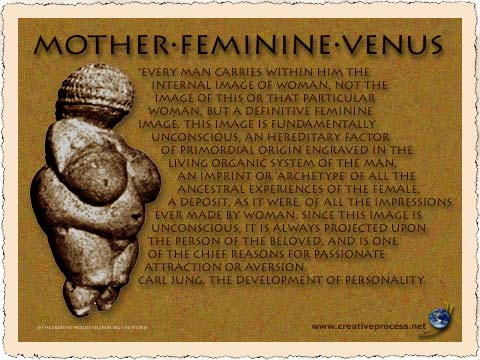
"Every man carries within him the eternal image of woman, not the image of this or that particular woman, but a definite feminine image. This image is fundamentally unconscious, an hereditary factor of primordial origin engraved in the living organic system of the man, an imprint or "archetype" of all the ancestral experiences of the female, a deposit, as it were, of all the impressions ever made by woman. ...Since this image is unconscious, it is always unconsciously projected upon the person of the beloved, and is one of the chief reasons for passionate attraction or aversion." par 338 The Development of Personality, Carl Jung (Papers on child psychology, education, and individuation, underlining the overwhelming importance of parents and teachers in the genesis of the intellectual, feeling, and emotional disorders of childhood. The final paper deals with marriage as an aid or obstacle to self-realization.)