 Fred Culver, a passionate soul and community activist, passed away on June 1, 2021, at Kansas City Hospice. He was born July 2, 1936, in Mason City, Iowa, to Dale and Jeanette Mac Millan Culver.
He and Nancy Culver had four children together: Deb (Paul) Stover, Michael (Cristie), Paul (Ericka de la Madrid), and Mark (Aimee Baird). Their grandchildren include Joe, Rachel, Robin, John Paul, Christine and Shannon, and Gianfranco and Isabella. He is survived by numerous nieces, nephews, great-grandchildren, his wife Rae Petersen, and stepdaughter Jessica. Fred was preceded in death by his sister, Joann Bonewits.
Fred graduated from Kansas City’s Westport High School and Missouri Valley College in Marshall, Missouri. Before attending Princeton Theological Seminary in New Jersey, he served in a circuit of churches in Central Missouri while teaching at the Postal one-room country school. He was ordained in the Westport Presbyterian Church and served in Wheatland, IA, and Midway Presbyterian Church in Chicago, IL.
After returning to Kansas City, Fred trained in Gestalt Therapy with Byron Eicher and formed Collegium Spiritus an ‘experiment in depth’ learning community. He also started The Creative Process by publishing portraits by Frank V. Szasz.
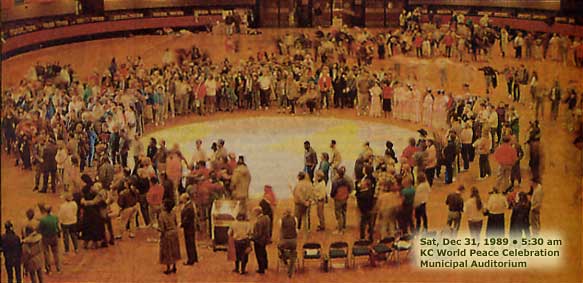
He helped lead the KC World Peace Celebration from 1986 to 2000 as The Future is Now organization. The Peace Celebration’s genesis included the Heart Forest at KCI, the Center for Global Community, and the Troost Ave. Festival.
Line drawing of Fred in 'group' by Sharon Eikeer.
A Bit about the Culverites:
On April 22, 1716, John Rogers and his wife Sarah, John Bolles and his wife Sarah, John Culver and his wife Sarah, and several others, names not given, entered the Congregational meetinghouse.
The cause of the disturbance is, as usual in affairs of this kind, studiously ignored on the court records, but evidently—as afterwards indicated—this entry, with scriptural testimony not revealed, was occasioned by the breaking up of Rogerene meetings by the town authorities, with the accompanying feature, a church-party mob.
As has been seen, the Rogerene meetings, not being among those allowed by law, can at any time be broken up at the pleasure or caprice of the authorities, and their continued existence has depended not upon the willing forbearance of the ecclesiastical rulers, nor, to any really saving extent, upon the public sympathy enlisted in their favor; but chiefly upon that formidable reserve power—the entrance into the meeting-house, with scriptural testimony.
https://www.gutenberg.org/files/55651/55651-h/55651-h.htm#Page_242



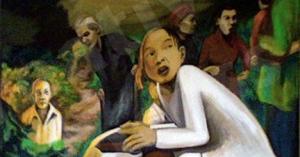
Fred loved to paint. This example is best described as a “Gestalt” painting—Gestalt is German for a “unified whole” or “pattern.” The painting depicts Fred’s experience of childhood with a mother who suffered spiritually. Fred believed that her spiritual suffering was treated primarily through its outward manifestation as profound depression.
The composition is based on a newspaper photograph and story from the Vietnam era. The frightened women—one carrying a basket in the foreground and others in the upper-right background—are terrorized by bombs falling from B-52 heavy bombers. Fred remembered the account describing the planes flying so high that they could neither be seen nor heard from the ground before the sudden, massive detonations below. He described this as an image of what it felt like as a child when his mother crashed into depression.
In the left foreground, facing outward, is Fred as a child. The green, inward-facing figure on the right is Fred as an adult, holding himself as a much younger child.
The greenish clouds in the background take on bird-like forms.
The path leads inward. I'm sorry I don't have a better image of the painting.


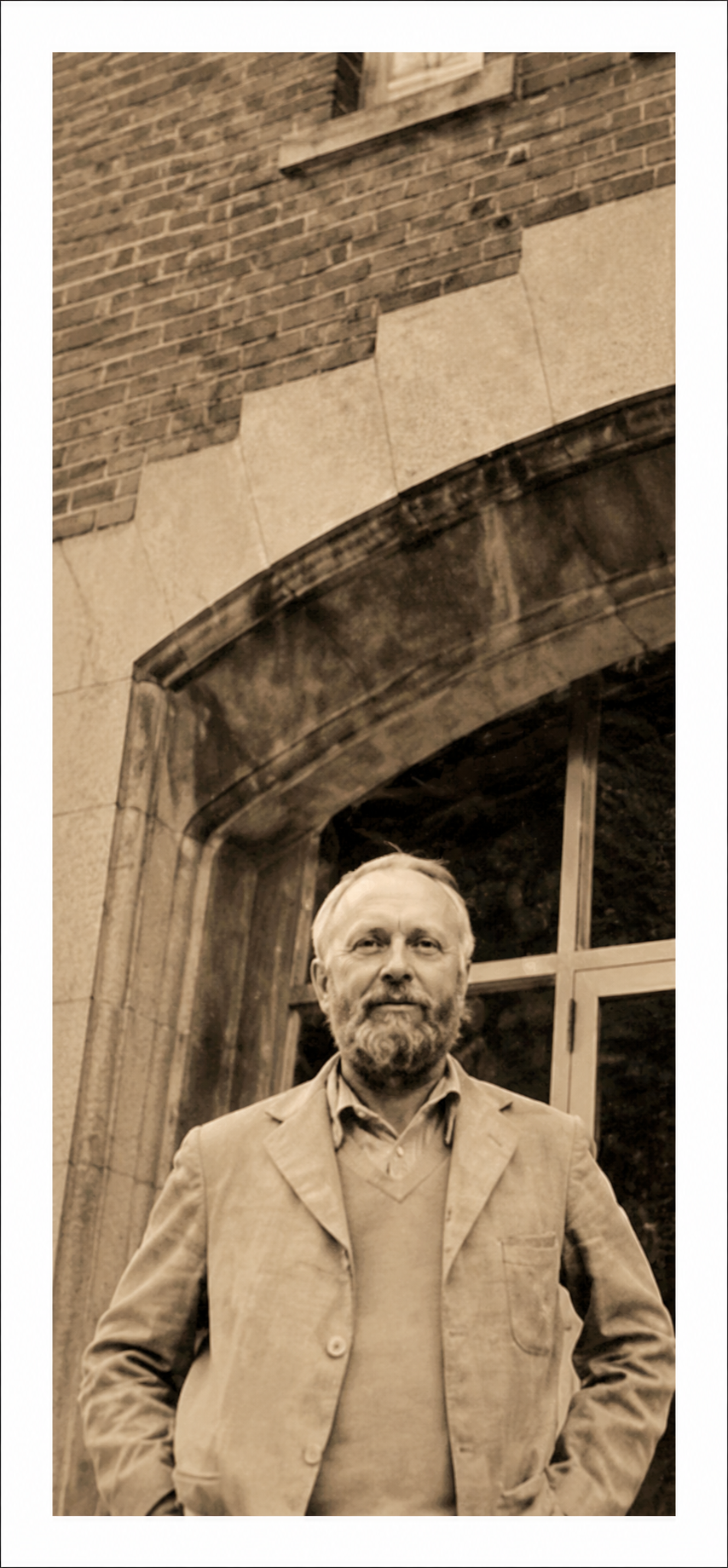
Fred Culver
Artists, Writers Work Together Community for Creative Studies
Based on KCStar article from Tuesday, March 8, 1977
— Fred Culver wanted to establish a community of artists and other creative people so much that, with the philosophical and financial support of two dozen friends, he bought several buildings on a city block to house such a center.
"When we went to close the deal, the title company was aghast: Deeds of trust (by participation contributors) as small as $1,000 on the buildings," said Culver, a Jungian philosopher and gestalt therapist. "I think it indicates there was and is real grassroots support for the dream."
This was last June. Today, the Community for Creative Studies, which occupies buildings 4524 to 4558 Main, houses artists' studios, a gallery for local art, theater, and mime, and facilities for writer's workshops, T'ai Chi instruction, and a gestalt group.
The dream is for a " community of genius," Culver explained." By genius, we do not mean something unattainable. We mean merely the courage to live out of one's own inner life, the courage of the individual to live originally."
Yasha Sklansky, a Russian-born photographer and cinematographer, and Frank Szasz, a portrait artist, were already renting space in the buildings when Culver and his associates arrived. Szasz is glad to see the center developing because, he said, it gives the artists a place to show their work and meet for mutual stimulation and encouragement.
At Community for Creative Studies, Ms. Lydia MacDonald runs an art showroom, Creative Process, which displays the work of 35 area artists. Four other artists—Richard Matthew, Robert Fagan, Suzanne Richards, and Joe Arnone—participate in community artistic ventures or share studio space in the buildings. The Mary Byrne Conry Studio and Gallery (where the Kansas City Art Coalition meets and keeps slides of artists' works) and Harry Fredman Studios are also in the buildings.
"We're an association of working professionals sharing our skills... You don't know how really discouraging it can be to work in a vacuum. I (John Wood) was a journalist in San Francisco for 15 years (working for the Associated Press, Time magazine, and McGraw-Hill) after leaving the Kansas City Star. Four years ago, I set up my own freelance studio. For the last two years, I have been working on a book, and I felt I would like a different environment to work in. I went to New York to find an intellectual community to share stimulation. But New York was in the midst of its own depression. So intellectually, it was a very down community, and hazards on the street were terrible."
The few successful intellectuals he met were living in high-rise, armory-type apartment buildings on $40,000 a year. Wood knew that Culver, his former Westport High School classmate, was forming a cultural center, so he returned here to help with it.
He and Culver think the Westport area is teeming with action in the arts and education. They point out that their center is near the Kansas City Art Institute, the University of Missouri-Kansas City and Conservatory of Music, several churches that promote cultural events and lectures, the New School of Human Education, the Learning Exchange, and Renascence Library. They try to keep in contact with creative individuals in these institutions.
Theater Workshop has moved from its River Quay location to space in the Community for Creative Studies. A permanent performance area will be ready in June, Jim Caines, technical director, said.
"We're close to all our audience here," Liz Gordon, chairman of Theater Workshop's board, said. Diana Mange, producing director, added, "We're right between the Plaza and Westport and you can't beat that... And older people who'd like to come to a matinee but don't want to travel all over town can come here."
Steve Harris, director of Mimewock (a mime troupe and school), likes the interchange of dramatic talents with Theater Workshop that is possible because of the proximity.
A psychologist, Dr. Fred de Wit, also has a private professional practice in the buildings. Another resource person and participant in the community is Ms. Karen Mitchell, who lectures in political science and women in politics at several colleges and is on the staff of Ottawa University.
Culver is a former Presbyterian minister who now considers himself an existential theologian. He conducts an ongoing gestalt group and hopes to begin one just for artists. He hopes to attract to the community on Main additional artists, writers, musicians, photographers and others self-employed in creative mediums.

Dialogos by Fred E. Culver
You are invited into our vocation of creating on Earth a single, learning community through the sacred work of transcultural dialogue.
We are the goal of the past and the beginning of levels still to come. In the child, we see our smallness and our vastness; we celebrate the potential in each person and revere the essence of the living universe.
Perfectibility, the principle underlying all life activity, draws human beings into connection with the primary, most pervasive processes of life, death and rebirth.
Through the resolution of opposites, we seek a spiritual awakening, overcoming and overreaching, within the transformative power of the deep unconscious.
Joy is our commitment and making friends is our method, enabling each other to live to capacity and creativity.
A sketch of our world*
...exploitive and extractive with widely shifting and fluctuating domestic and
international economics, resulting in
• fierce competition for limited resources,
severe destruction of the biosphere,
racial, ethnic, national, and religious conflicts throughout the world,
with a consequent failure of intimacy, all fueled by a tremendous increase in population.
* this description of our world is based on United States Department of Education
literature promoting goals for year 2000.
enable... beyond coerce
systemic... beyond single focus
spiritual... beyond compliance


Watch "We Are Superman" on YouTube. A documentary film about Troost, Kansas City, Racism, White-Flight, Justice, Community, Citizenship, Personal Responsibility, Economic Longevity, and DIY.